In 480 BCE, Athens spent a windfall of silver from the Laurion mines on two hundred warships. Those ships destroyed Xerxes’ fleet at Salamis and saved the city. The silver had been dug from galleries under a metre high by enslaved workers who rarely survived their thirties, breathing fine lead dust by torchlight with no ventilation. That single chain of cause and consequence captures the essential tension of daily life in ancient Greece: a civilisation of extraordinary intellectual and civic achievement built on a foundation of exploitation so normal that the literature celebrating the achievement barely noticed it. This article uses the excavated evidence, from the bronze jury ballots recovered at the Athenian Agora to the waterproofed andron floors of elite dining rooms and the seven hundred mine shafts at Laurion, to examine what Greeks of every status actually did between sunrise and the last cup of the evening.
The Athenian Agora: Where Daily Life in Ancient Greece Played Out in Public
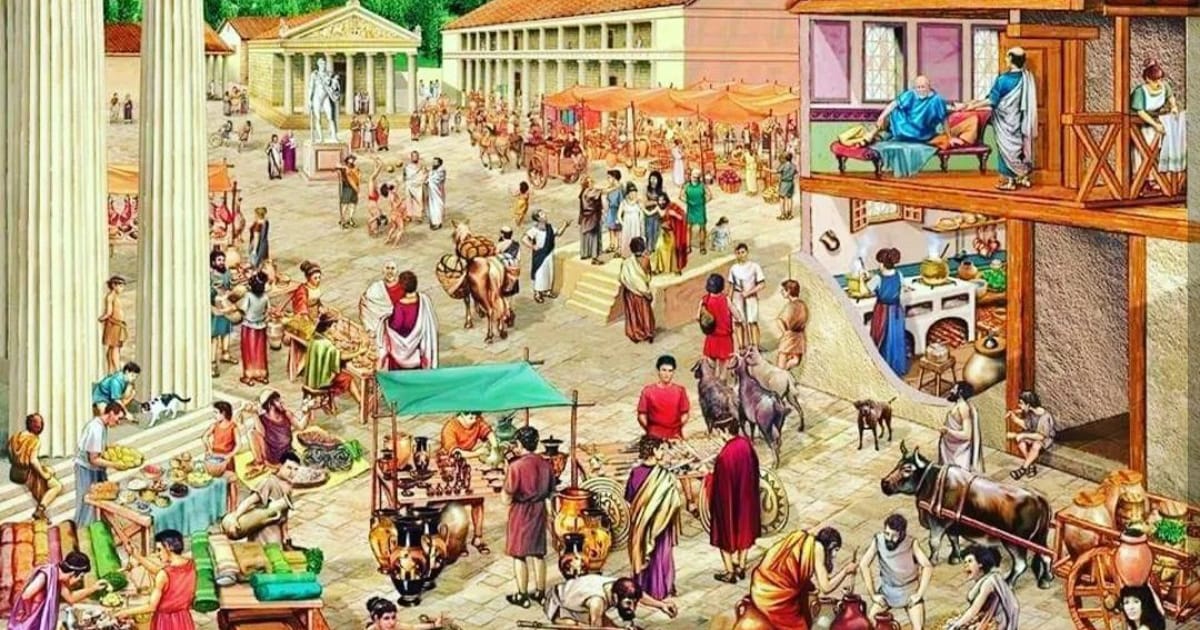
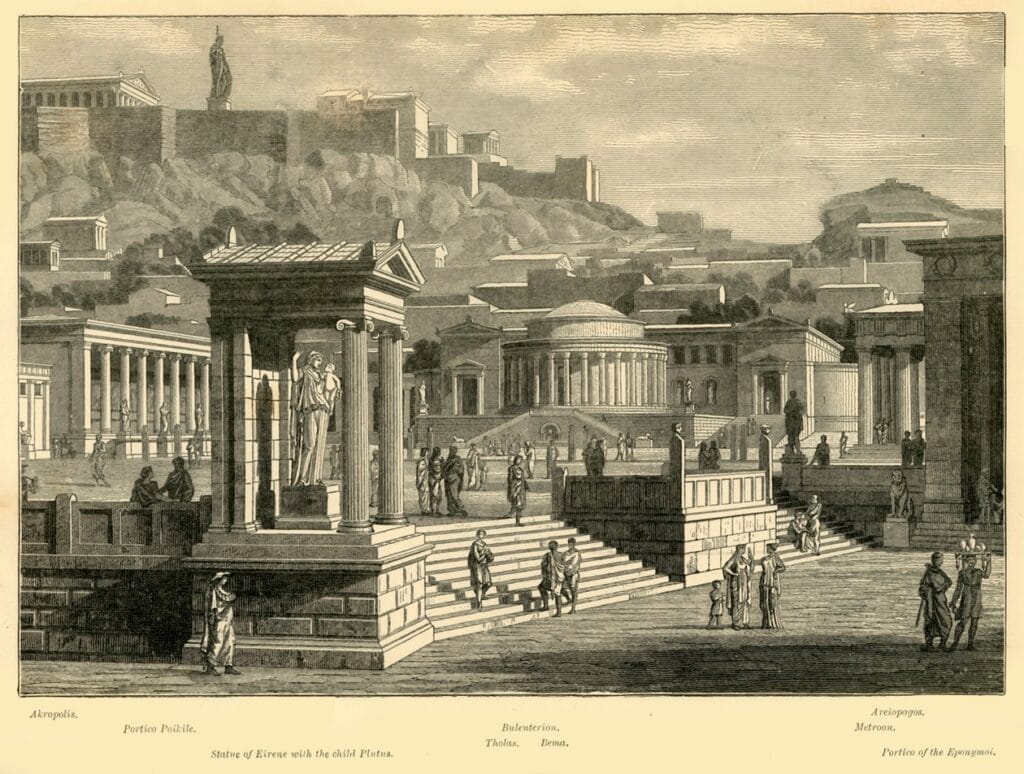
The Athenian Agora was not a marketplace in the modern sense. It was the administrative and commercial heart of the city, a thirty-acre space where fish merchants, jurors, bronze-founders, and professional scribes operated within metres of each other from before sunrise. The American School of Classical Studies at Athens has excavated the site continuously since 1931, recovering bronze jurors’ identification tickets, official weight and measure standards, clay ballots, and building foundations that reconstruct daily civic function in forensic detail. What emerges is not the serene marble plaza of popular imagination but a crowded, noisy, multi-purpose space in which commerce, justice, and politics were physically inseparable.
Fish from the Piraeus harbour arrived before the Mediterranean heat made it dangerous and was spread on salt-slicked boards by merchants who had walked before dawn. Potters stacked amphorae against the colonnades. Barbers positioned near the Stoa Basileios, where the law courts operated, filled early with men heading to jury service. A shave cost a few obols and included intelligence on Macedonian troop movements and theatrical gossip that no official notice board could match. The agoranomoi, the market magistrates, circulated with bronze standard weights to check traders’ scales against the official measures. Aristophanes makes jokes about market fraud in three separate plays, which indicates it was not a periodic scandal but a structural feature of commercial life that every Athenian understood and most accepted.
Chian wine arrived in handled amphorae whose profiles pottery specialists can now attribute to specific island kilns by shape alone. Euboean figs sat alongside Egyptian papyrus. Black Sea dried tuna competed with fresh catches from the Saronic Gulf. Professional scribes rented booths where illiterate farmers could dictate legal complaints for a fee. The political machinery of Athenian democracy operated in the same thirty acres. Citizens exercised their rights as jurors, assembly voters, and civic witnesses in the same space where they bought their barley and fish. This proximity was deliberate. Athenian democracy required physical presence, and the Agora made civic participation unavoidable for anyone who needed to eat.
The Oikos: The Household Economy That Made Everything Else Possible
The word oikos described not just a physical house but a complete economic unit: the family, the property, the enslaved workforce, and the productive output they collectively generated. Aristotle opens his Politics with the oikos as the foundational unit of the state, and he was accurate in a material sense. Everything that happened at the Agora, in the theatre, and on the battlefield depended on what was managed inside the household walls first. Grain had to be ground before bread could be baked. Wool had to be spun and woven before clothes could be worn. Oil had to be stored in the correct proportions before the lamp could be lit and the accounts reviewed.
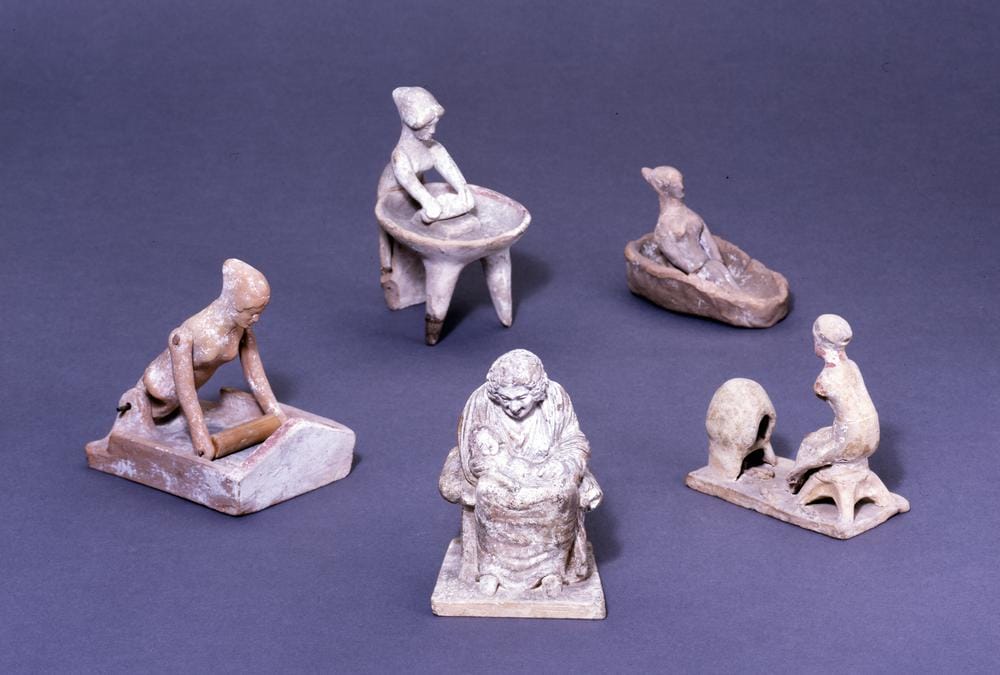
That management fell primarily to women. Lisa Nevett of the University of Michigan, in her foundational study of classical Greek domestic archaeology published in the Annual of the British School at Athens, found that loom weights, cooking braziers, and storage vessels appeared across multiple rooms of excavated houses at Olynthus rather than in fixed gendered zones as the literary sources implied. Women moved through the entire household to manage grain stores, oversee weaving, and direct enslaved workers through tasks ranging from grinding flour on heavy stone querns to carrying amphorae to market. The image of the wholly secluded Athenian wife was a legal and literary construct that the physical evidence from excavation repeatedly qualifies and complicates.
Athenian wives married in their mid-teens to men a decade or more their senior and had no political rights or independent legal standing. The male kyrios represented the family in court and at the assembly. But funerary stelae from the fifth and fourth centuries BCE in the National Archaeological Museum in Athens consistently commemorate women for household management skill alongside personal virtue, not because it was unusual but because it was genuinely valued. Spartan women occupied a completely different position. They owned and managed land in their own names, trained physically in public gymnasia, and spoke openly in public. Bone density and muscle attachment patterns in female skeletal remains from Spartan burial contexts confirm sustained strenuous physical activity at levels well above those found in Athenian female skeletons. Both cities measured female worth through the bearing of sons, but the daily texture of female life across the two poleis had almost nothing in common beyond that single expectation.
What Ancient Greeks Actually Ate
The Greek diet rested on three pillars: barley, olive oil, and wine. Barley ground into a thick paste called maza was the daily staple for the majority of the population at every income level. Wheat bread was more expensive and carried connotations of prosperity. Victor Davis Hanson argued in his 1995 study The Other Greeks that the cultivation of precisely these three crops shaped Greek civilisation more fundamentally than any philosophical school, because they determined the agricultural calendar, the structure of the peasant economy, and the territorial logic of the polis itself. Attica’s thin limestone soil and dry summers were unsuited to grain but ideal for olive trees, which meant Athens was structurally dependent on imported grain from the Black Sea and structurally oriented toward maritime trade from the beginning of its political history.
The late morning meal, called ariston, typically included bread or maza, olives from the household pithoi, goat or sheep cheese, and salted or dried fish. The Athenian relationship with fish bordered on cultural obsession. Comedy writers mocked it in play after play, and bone assemblages from residential middens across Attica show fish consumption at every income level, with Black Sea preserved tuna appearing in modest rural farmstead refuse as regularly as in wealthy urban households. Meat was overwhelmingly a festival food. Its consumption was tied mechanically to animal sacrifice: the gods received organs and smoke at the altar, and the worshippers received the remainder, cooked communally on sanctuary grounds. A poor man who could not afford his own animal still ate meat at the public feasts organised by his deme several dozen times each year. Religion and nutrition were, for most Athenians, the same transaction.
Wine was drunk daily by every adult Greek, always diluted with water. Drinking wine unmixed was a marker of barbarian behaviour and moral failure. The standard symposium mixture of three parts water to one part wine produced an alcohol content roughly comparable to modern light beer, though the wine itself was often syrupy and thick, concentrated during production to a level far above modern table wine. The ratio was not fixed. The symposiarchos, the host responsible for regulating the evening, chose the mixture and the rate of drinking for the entire company. A host who pushed for stronger mixtures was announcing a particular kind of night. One who kept things dilute was stating that serious intellectual work was expected, a distinction every guest understood immediately.
Built out of a love for history, kept free from distractions.
Spoken Past is an independent project shaped by curiosity, care, and long hours of research. Reader support helps keep it maintained, carefully researched, and open to everyone.
The Symposium: Wine, Philosophy, and the Game of Kottabos
The Greek symposium was not a dinner party with intellectual pretensions. It was a tightly structured ritual with its own purpose-built architecture, specific equipment manufactured to precise specifications, a host with a formally defined regulatory role, and a dual identity as both competitive drinking occasion and intellectual performance that no modern institution quite replicates. Understanding what actually happened in the room requires looking at the floor.
Archaeologists identify andron dining rooms with certainty because of a single physical feature: waterproofed floors. The central area was sealed against liquid while a raised border ran along the walls where the klinai, the reclining couches, stood. The reason for waterproofing emerges directly from the University of Colorado Boulder Classics Department’s analysis of Greek symposium culture: the most popular after-dinner game, kottabos, required guests to swing their kylix cups in a specific arc and hurl the wine lees across the room at a bronze target on a central stand, calling out the name of a person they desired as they threw. The floor was waterproofed because the evening reliably ended with wine spread across every centimetre of it.
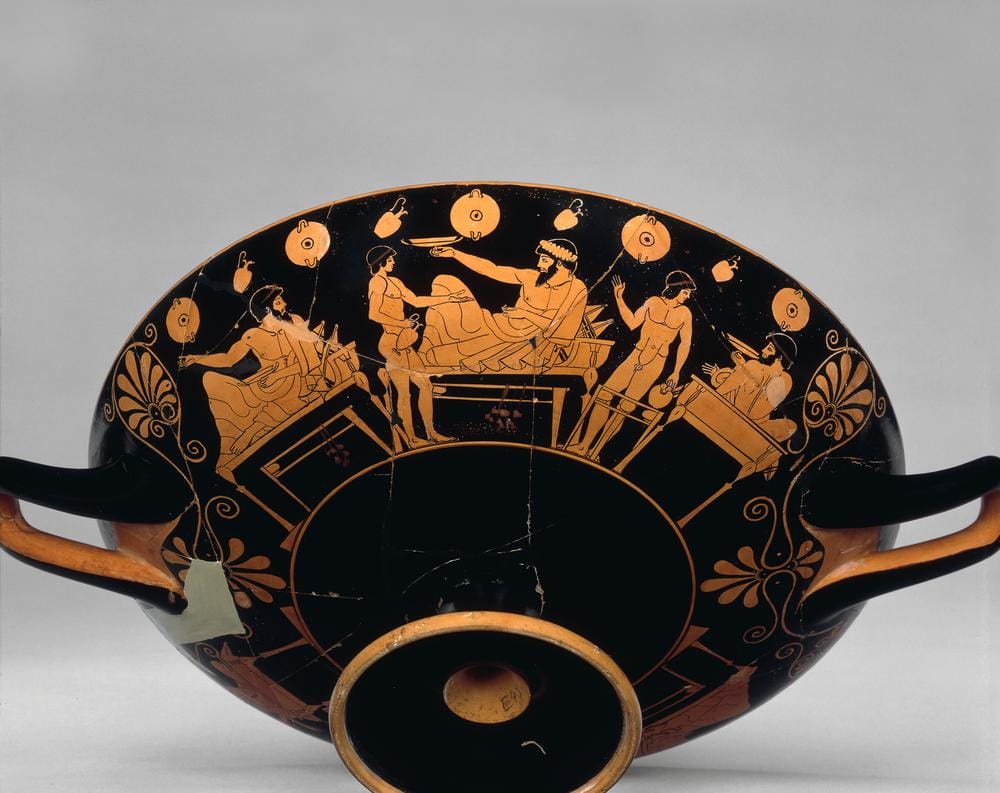
The kylix, the broad shallow cup shown above, was engineered for exactly this dual function. Wide enough to hold a meaningful quantity of diluted wine for drinking, shallow enough to generate a long lees trajectory when swung from a reclining position, it appears in Athenian red-figure pottery throughout the fifth and fourth centuries BCE in precisely the symposium contexts the andron floor evidence confirms. Between kottabos rounds, guests competed in skolia, improvised sung verses passed around the room in which each participant had to respond to the previous line in meter. Aulos players, hired women providing double-reed background music, maintained rhythm between bouts of argument and improvised song. Plato set his Symposium on an evening where the mixture was deliberately kept dilute because the group had agreed in advance that philosophical discussion, not competitive drinking, was the evening’s purpose. Xenophon’s version features a hired juggler whose sword dance quietly ended a political argument that had been escalating toward something uglier.
Religion in Every Transaction
Greek religion was not a weekly observance. It was threaded through every threshold crossed, every meal begun, every ship launched, and every legal complaint filed. Before anyone ate in a Greek household, the woman of the house fed the hearth fire with a pinch of barley and a few drops of wine for Hestia. Before a ship left harbour, a goat was sacrificed and its liver examined for favourable signs. Before a major lawsuit was argued, the plaintiff made an offering at the relevant sanctuary. The Athenian religious calendar held over a hundred festival days annually, and absence from the major ones was not a neutral social act in a city where civic identity and religious participation were the same thing.
The City Dionysia, held each spring, was the most significant cultural event of the Athenian year. It drew the entire citizen body to the Theatre of Dionysus on the south slope of the Acropolis, which seated approximately fourteen thousand people, where tragedies and comedies competed over several days for judges’ prizes funded by wealthy citizens called choregoi. Losing choregoi paid fines for poor productions. Winning ones received bronze tripods displayed permanently in the street outside the theatre as monuments to their civic generosity. Entire demes marched to the event with food for the day packed in baskets. The theatre was simultaneously religious observance, civic assembly, and cultural competition, all compressed into a single institution on a single hillside, which is why Greek drama produced Aeschylus, Sophocles, Euripides, and Aristophanes within a single century.
Private religion operated through a parallel vocabulary of protective objects and gestures. Knotted wool cords bound around children’s wrists were meant to deflect phthonos, the evil eye directed by envious neighbours. Herms, stone pillars topped with a bearded male head, stood at doorways throughout Athens as boundary guardians. Rolled lead tablets inscribed with curses against business rivals, legal opponents, and unfaithful lovers, and small terracotta figurines, appear in grave contexts from every income level across the Attic archaeological record. The oracle networks at Delphi and Dodona functioned as interstate advisory systems consulted by cities on questions of war, law, and colony foundation. Individual Greeks consulted smaller local oracles at cave shrines and sacred springs for questions ranging from illness to disputed inheritance and unresolved paternity.
Slavery at Laurion and in the Household
The Athenian democracy that produced the Parthenon, Sophocles, and trial by jury rested on an enslaved population that scholars estimate comprised between a quarter and a third of Attica’s total inhabitants at the height of the classical period. The institution ranged from the relatively privileged household pedagogue, who accompanied elite boys to school and was sometimes trusted with accounting and purchasing, to the mine worker at Laurion for whom enslavement was a death sentence measured in single-digit years. The lead tablet recovered from the Athenian Agora excavations, inscribed by an enslaved man named Lesis writing to his owner, is one of the rarest objects in the entire ancient record: direct evidence that an enslaved person in classical Athens was literate, trusted with writing materials, and possessed enough social latitude to communicate directly with the man who owned him.
The Laurion silver mines sixty kilometres south of Athens were a different world. Isotope analysis of surviving Athenian tetradrachm coins has confirmed that their silver came almost exclusively from the Laurion seam deposits. Archaeologists have identified over seven hundred ancient mine shafts and approximately two hundred ore-processing stations across the site. At peak production in the fifth and fourth centuries BCE, around twenty thousand enslaved workers drove those shafts through solid rock using iron hammers and chisels in galleries sometimes under a metre in height, by torchlight, breathing fine lead dust with every breath. Xenophon’s Poroi records that the general Nicias rented out a thousand enslaved men to mining contractors at one obol per man per day, accounting for them as depreciating capital assets in an investment ledger. The British School at Athens, through its long-running Olynthus Project, has documented the household end of this labour system across multiple excavated sites in northern Greece.
Sparta’s version was structurally distinct and, by its own formal mechanisms, more violent. The helots of Messenia, a population conquered in the eighth century BCE and bound to the land as state serfs, outnumbered their Spartan masters by at least seven to one in the classical period. Every autumn the Spartan ephors formally declared ritual war on the helots, providing legal cover for the krypteia: roving bands of young Spartan warriors who killed helots deemed too confident, too prosperous, or too visible after dark. The mechanism served two purposes simultaneously. It eliminated potential leaders of helot revolt and it trained young Spartans in the skills of night movement and targeted killing that the agoge, the Spartan education system, placed at the centre of male formation. When the Theban general Epaminondas liberated Messenia in 369 BCE, freed helots reportedly wept in the streets and sang hymns outside the walls of a city they could finally call their own. That moment, preserved in Plutarch’s account of Epaminondas, is one of the rare places the ancient sources allow the inner experience of enslaved people into the record at all.
The Gymnasium, the Palaestra, and Greek Paideia
Greek education did not separate the physical from the intellectual because its guiding ideal, kalokagathia, held that moral excellence and physical excellence were expressions of the same underlying quality of character. A gymnasium was simultaneously a sports ground, a site of philosophical discussion, and a social network where political alliances and mentorships formed. Socrates conducted some of his most documented conversations in the palaestra. The architecture made this overlap structurally inevitable: exercise, intellectual display, and civic socialising happened in the same space, before the same audience of citizens, at the same time every day.
Boys from citizen families began formal schooling around age seven, studying reading and writing with a grammatistes, music with a kitharistes, and physical training in the palaestra with a paidotribes. Homer sat at the centre of the curriculum. Every educated Athenian had large sections of the Iliad and Odyssey memorised not as cultural decoration but as the primary practical and ethical manual for understanding courage, fate, and behaviour under pressure. Physical training included wrestling, sprinting, jumping, javelin throwing, and discus. After exercise, athletes coated their bodies with olive oil mixed with fine sand before training, then scraped both off with a bronze strigil. The residue, called gloios, was collected and sold as medicine, a commercial transaction attested in both literary sources and market records that tells you something about the Greek talent for extracting commercial value from every conceivable byproduct of daily activity.
Military training shadowed athletic training throughout a Athenian male citizen’s formation. The hoplite phalanx required mass physical coordination under the weight of a full bronze panoplia in summer heat, and only years of gymnasium conditioning produced men capable of holding position when a hostile formation hit the line. The pyknosis manoeuvre, in which the phalanx tightened its ranks until overlapping shields formed a single moving wall of bronze, required exactly the kind of collective physical response that years of wrestling and close-contact training encoded into muscle memory. Athenian political theory therefore treated the gymnasium not as a private leisure facility but as a civic institution producing the bodies the democracy needed to survive.