
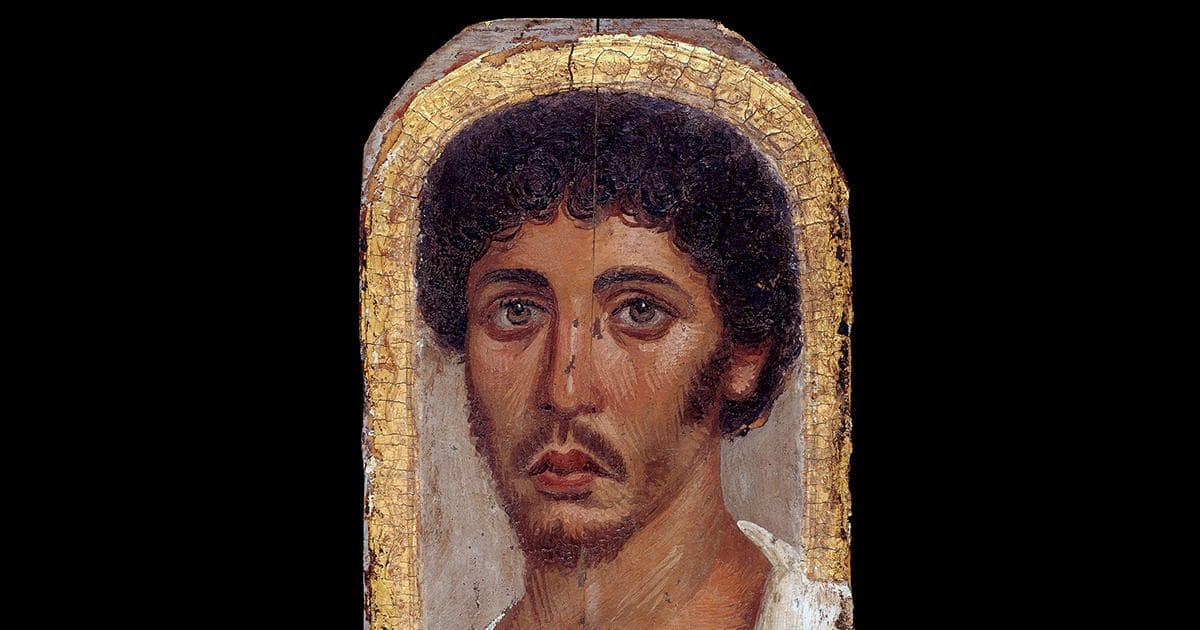
In 1887, the British archaeologist W. M. Flinders Petrie arrived at the cemetery of Hawara in the Faiyum basin, roughly 100 kilometres south of Cairo, and began lifting mummies from their sandy graves. What he found wrapped into the linen bindings over the faces of the dead stopped him. These were paintings. Wooden panels, no thicker than a finger in some cases, bearing portraits rendered in hot beeswax and coloured pigments with a directness and psychological confidence that felt nothing like the stylised two-dimensionality of Pharaonic art. Petrie would return to Hawara in 1911, and a German expedition mounted a parallel dig in the 1890s, but the core discovery was already clear: Roman Egypt had produced a body of panel painting that modern specialists now call the Fayum mummy portraits, and it is one of the only large surviving groups of easel-scale painting from the entire classical world. This article examines how they were made, what the technical science of the past decade has revealed about them, and why so many scholarly questions about their production and purpose remain open.
What the Fayum Mummy Portraits Are and Where They Come From
The label “Fayum mummy portraits” is geographical shorthand for a much wider phenomenon. Panels have been found across Roman-period Egypt, not only in the Faiyum oasis but at Antinoopolis on the east bank of the Nile, at Thebes, at Memphis, and at dozens of smaller cemeteries stretching the length of the country. The Faiyum designation has stuck because the most intensively excavated and documented cemeteries, Hawara and er-Rubayat, the burial ground of the ancient city of Philadelphia, both happen to lie within the Faiyum basin. Scholars treat “Fayum” as a stylistic term, not a geographic one, following the consensus established in the 2000 Metropolitan Museum of Art exhibition “Ancient Faces,” curated by Susan Walker of the British Museum and Morris Bierbrier. That exhibition, which assembled approximately seventy panels from collections in Europe and North America, remains the most influential single event in bringing these works to sustained public and scholarly attention.
The portraits were made during Roman rule in Egypt, a period that began with the Battle of Actium in 30 BCE and the death of Cleopatra VII. The Roman province of Egypt held a special status as the personal property of the emperor, administered by a prefect rather than a senatorial governor, which created unusual conditions of cultural hybridization. The Hellenised Egyptian elite who commissioned these portraits inhabited a world where Greek remained the language of administration and culture, Roman fashions circulated through the imperial court and into the provinces within years of their adoption in Rome, and the ancient Egyptian tradition of mummification had been practised for over two thousand years. The Fayum mummy portraits are the product of all three of these streams meeting in a single object. The painting technique is Roman and Greek. The purpose is Egyptian. The sitter presents themselves in terms of imperial fashion.
About 900 panels survive today in museum collections across the world, the largest groups at the Metropolitan Museum of Art in New York, the British Museum in London, the Louvre in Paris, the Antikensammlungen in Munich, and the Ägyptisches Museum in Berlin. A smaller but well-studied group of sixteen panels is held at the J. Paul Getty Museum in Malibu, which since 2013 has been the institutional home of the most ambitious technical research project ever mounted on these paintings, the APPEAR initiative described below. Almost all surviving portraits were separated from their mummies during the excavations and dealing activity of the late nineteenth century, a fact that has severely complicated both provenance research and archaeological interpretation.
Encaustic and Tempera: The Two Techniques and Their Different Demands
The Fayum mummy portraits divide into two main technical groups, differentiated by their binding medium: encaustic and tempera. Understanding the difference between them matters not only for art history but for understanding the social world of Roman Egypt, because the two media were not interchangeable and the choice between them reflected access to specialist knowledge, material cost, and probably workshop affiliation.
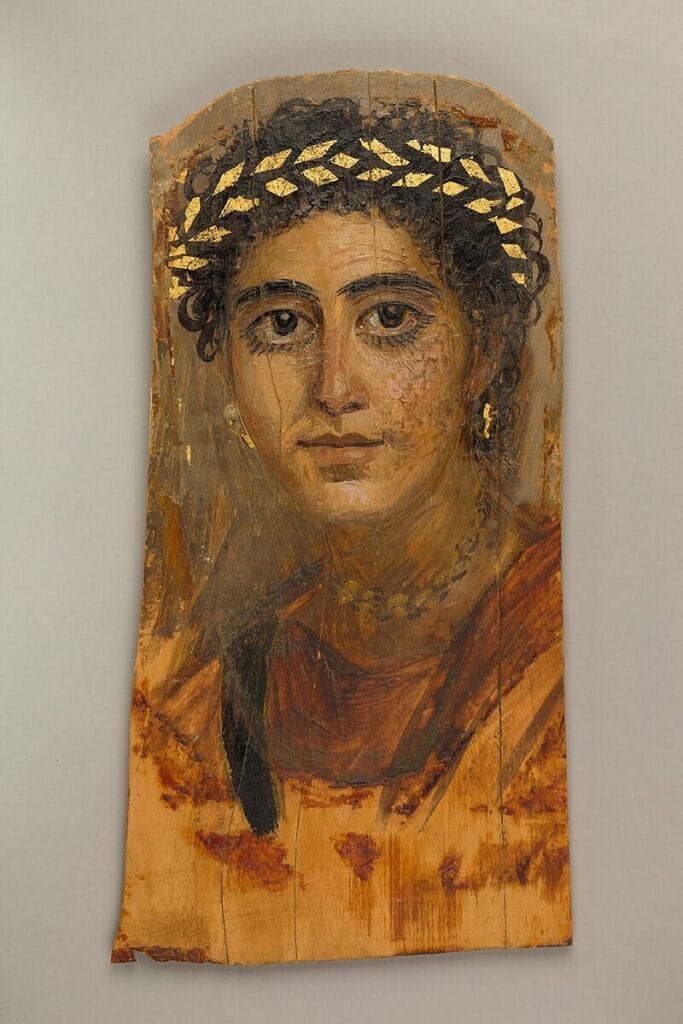
Encaustic is the older and more prestigious technique. The word derives from the Greek enkaustikos, meaning burnt in, which describes the fundamental process: the painter works with beeswax that has been melted, coloured with mineral and organic pigments, and applied while still warm using a brush, a spatula called a cestrum, or a heated tool called a cauterium. The wax is kept fluid through the session by warming it on a small brazier. As it cools on the panel surface, it fuses the pigment particles into a semi-translucent matrix that allows for extraordinary tonal modelling: shadows can be built through transparent washes, highlights can be laid as thick impasto ridges that physically stand above the panel surface, and the warm colours of flesh tones can be modulated by mixing ochres, lead white, and organic reds in combinations too subtle to achieve in water-based media. Ancient authors including Pliny the Elder in his Natural History, Book XXXV, praise encaustic as the superior technique for portraiture precisely because it could capture the warm, luminous quality of skin.
Tempera binds pigments in a water-soluble medium, typically animal glue in the case of these panels, rather than in wax. It dries quickly, produces a matte surface rather than the slight sheen of wax, and requires a different working method: the painter must work in rapid, decisive strokes because no blending or reworking is possible once the paint sets. Tempera portraits are recognisable by their relatively flat tonal transitions, their crisp linear contours, and a chalky quality in the whites and pale tones that encaustic panels do not share. Art historians theorize that wealthier sitters favoured encaustic, which required more expensive materials and a higher level of technical training, while tempera served clients with more modest budgets. The scholarly literature, including research published in the APPEAR conference volume edited by Marie Svoboda and Caroline Cartwright (Getty Publications, 2020), confirms that encaustic and tempera were sometimes used together on a single panel, with one medium used for the flesh tones and another for the dark background or the hair.
The APPEAR Project and What Modern Science Has Changed
For most of their modern scholarly life, the Fayum mummy portraits were studied primarily as art objects, analysed for style and dated by the hairstyles and jewellery of their sitters. The idea that they could be studied as material artifacts, their wood identified to species by microscopy, their pigments mapped to specific quarry sources, their binders characterised by gas chromatography, was only systematically realised in 2013 when Marie Svoboda, conservator of antiquities at the J. Paul Getty Museum, launched the APPEAR project (Ancient Panel Paintings: Examination, Analysis, and Research). The initiative has since grown to involve forty-two institutions across five countries and has produced the most comprehensive technical database of ancient panel paintings ever assembled.
The wood identification work, led by Caroline Cartwright, senior scientist in the Department of Scientific Research at the British Museum, has confirmed that linden (Tilia sp., also known as lime wood) is the most common support for encaustic panels, followed by cedar of Lebanon, sycamore fig, and cypress. Linden was imported into Egypt, where no native stands grew, which means that selecting it for a portrait panel was itself a marker of expenditure. Some panels in the APPEAR database were made from recycled wood. The Getty’s own collection includes one panel that was originally part of a construction timber dating to approximately 600 BCE, repurposed for a portrait made six or seven centuries later. The panel is less than two millimetres thick, the result of the wood having been planed down to the minimum viable working surface to extract usable material from an already-seasoned piece.
Pigment analysis has produced several notable findings. Egyptian blue, the ancient synthetic pigment based on calcium copper silicate and known from Egyptian art since the Old Kingdom period around 2600 BCE, appears in these portraits in ways that are invisible to the naked eye. Under visible-induced luminescence imaging, a technique that causes the pigment to emit near-infrared radiation, Egyptian blue glows in areas where no blue is visible in ordinary light. Painters used tiny quantities of it mixed into flesh tones, shadow areas, and background passages to create subtle colour effects that shift the optical impression without registering as blue to a viewer standing at normal distance. This discovery, first documented in detail by researchers at Northwestern University working with the Hearst Museum of Anthropology, and confirmed by subsequent APPEAR analyses, reveals a level of deliberate optical engineering in these portraits that was entirely unsuspected before scientific imaging became routine.
The APPEAR project has also transformed provenance research. Judith Barr’s contribution to the 2020 APPEAR volume, published freely online by Getty Publications, documented how stamps, dealer marks, and export seals on the reverses of panels photographed during imaging sessions allowed researchers to trace portraits previously listed as having unknown provenance back to specific collections and trading networks active in the late nineteenth and early twentieth centuries. One portrait in the Los Angeles County Museum of Art, donated in 1971 with no prior provenance, was identified as carrying a Graf stamp: a mark of the collection of Karl Ludwig Theodor Graf, the Viennese dealer who sold the first major group of these portraits to European buyers in 1887, within months of Petrie’s Hawara excavations. A second volume of APPEAR research, covering the 2022 conference at the Allard Pierson Museum in Amsterdam, was scheduled for release in February 2026.
Dating the Portraits: Hairstyles, Jewellery, and the Problems of Chronology
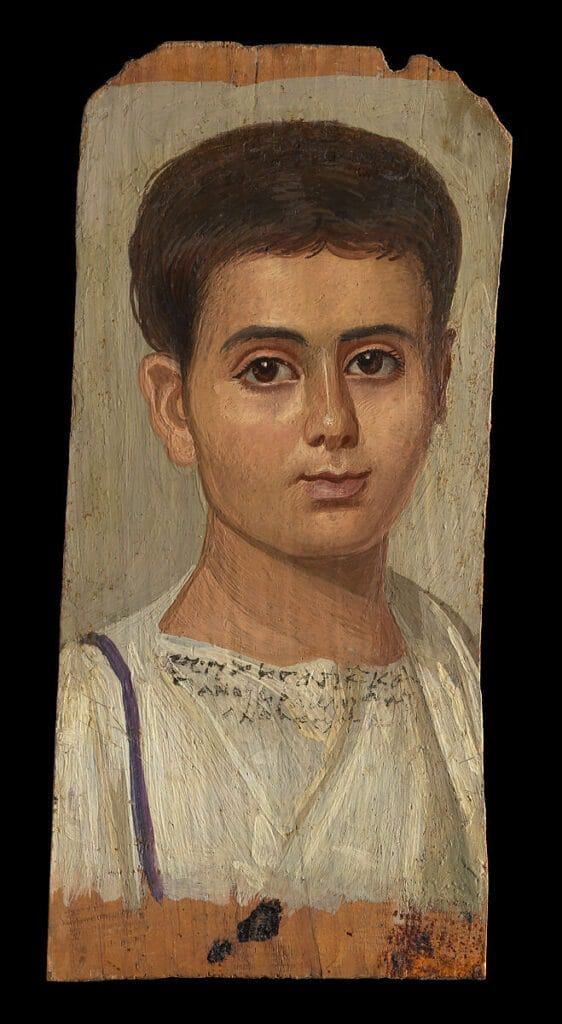
The dating of the Fayum mummy portraits is, as the Metropolitan Museum’s exhibition catalogue frankly stated, “a hotly debated subject among scholars.” The broad consensus places the beginning of the tradition around 30 to 40 CE, in the early Imperial period, and most securely datable encaustic panels fall within the first three centuries CE. But the end point of tempera painting in particular remains contentious, with some scholars arguing for continuation into the fourth century CE, long after encaustic appears to have ceased.
The primary dating tool is hairstyle. Women’s coiffures in the Roman world changed substantially with each imperial dynasty. The elaborate piled-up curls of the Flavian period, c. 69 to 96 CE, are immediately recognisable and datable to within a generation. The simpler central-parted waves of the Trajanic and Hadrianic period, c. 98 to 138 CE, represent a different aesthetic tied to specific court fashions. A woman wearing a complex Flavian wig cannot be a painting from the Severan period, c. 193 to 235 CE, when those styles had been out of fashion for over a century. Men’s beard styles undergo a similarly dateable evolution: Trajan was clean-shaven, Hadrian introduced the full beard, and the fashion persisted through the Antonine dynasty with variations in length and shaping. A bearded young man in a portrait can be assigned to roughly the second century CE on this basis alone.
Jewellery provides a secondary chronological signal. Pearl earrings in the form of a central gem with two pendant pearls below, a design visible on several Met portraits including the young woman in red dated to 90 to 120 CE (accession no. 09.181.6), are attested in Roman goldsmithing contexts with enough precision to bracket a portrait to a span of two or three decades. The gilded wreath, a common accessory in these paintings, does not date as precisely but does indicate the portraiture of someone wealthy enough to afford genuine goldwork or high-quality gilded imitations. The Walters Art Museum’s technical examination of two portraits in their collection, published in the Walters Journal vol. 74, identified one sitter’s coiled braids as characteristic of the Trajanic to Hadrianic period and confirmed this stylistic dating through analysis of the linden support and encaustic layer composition.
Built out of a love for history, kept free from distractions.
Spoken Past is an independent project shaped by curiosity, care, and long hours of research. Reader support helps keep it maintained, carefully researched, and open to everyone.
Workshops, Named Masters, and the Evidence for Travelling Painters
The Fayum mummy portraits were not produced by isolated individual craftsmen. They came from organised workshops that standardised procedures, trained apprentices, maintained pattern books, and probably worked alongside specialist carpenters who prepared panels to standard dimensions and embalmers who integrated finished paintings into the mummy wrappings. Recognising workshop groupings has been one of the more productive areas of recent scholarship.
The most celebrated named entity in the Fayum portrait corpus is the “Isidora Master,” a workshop designation assigned by art historians to a group of panels whose stylistic consistency suggests a single highly skilled painter or a closely supervised atelier working in the Faiyum around the early to mid second century CE. The Getty Museum’s mummy portrait of a woman, accession no. 81.AP.42, is attributed to this master, as is a related panel in the University of Mississippi Museum. Both show the same characteristic handling of the eyes: an elongated almond shape with a prominent dark upper lid line, a catchlight placed at the upper left of the iris, and lashes rendered in short rapid strokes rather than the heavier line approach common in other workshops. Whether these similarities represent one painter working over a career of twenty or thirty years or a close workshop tradition is the kind of question that APPEAR’s cross-institutional comparisons are designed to address.
The literary evidence, notably passages in ancient papyri from the Faiyum itself, confirms that painters were sometimes itinerant, travelling between towns to complete commissions. One second-century CE papyrus from Arsinoe, the capital of the Faiyum nome (administrative district), records a contract between a painter and a client specifying the materials to be used, the price, and the delivery date for a portrait. This is not a mummy portrait commission specifically, but it confirms the commercial and contractual nature of painting work in Roman Egypt. The presence of both encaustic and tempera panels at the cemetery of er-Rubayat, noted by the Met’s exhibition catalogue, shows that different workshops or different painters from the same workshop could serve the same burial ground simultaneously, competing for clients on the basis of technique, price, or reputation.
The Life of a Panel Before and After Death
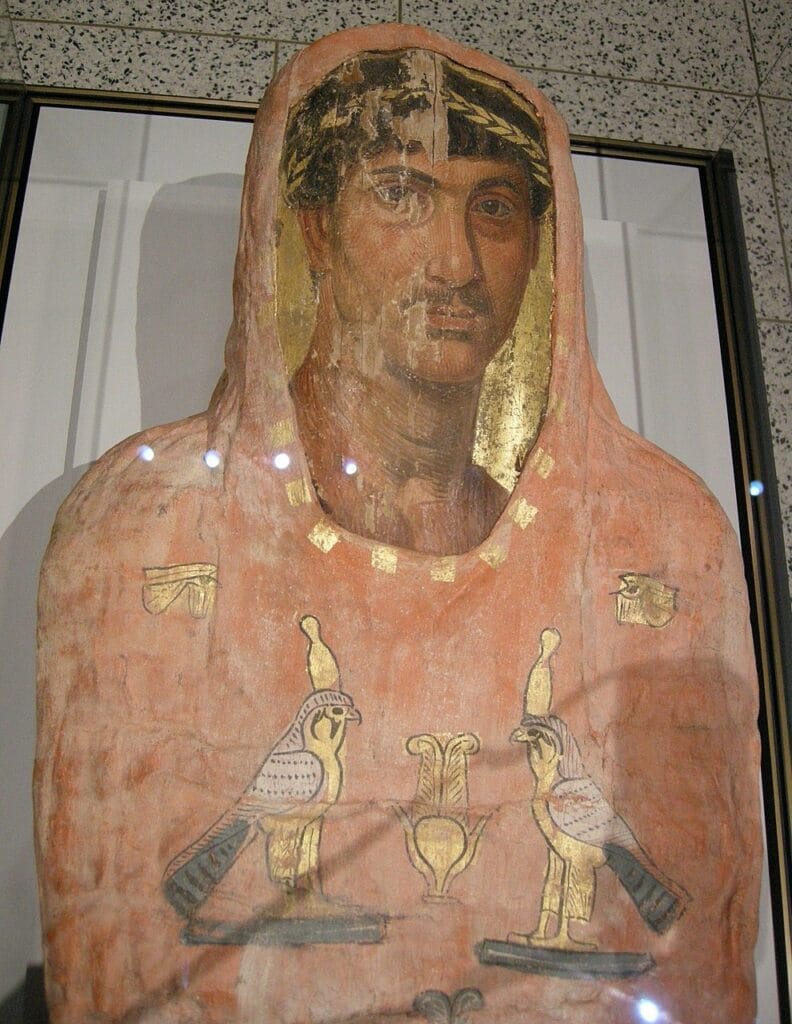
One of the most persistently discussed questions about the Fayum mummy portraits is whether they were painted during the sitter’s lifetime or posthumously. The question matters for interpretation: a portrait painted from life is a record of how an individual appeared at a particular moment; a portrait painted after death is a memorial construction. Some panels show signs of having been hung in domestic spaces before burial: nail holes at the top edge, surface wear from handling, and minor damages inconsistent with a freshly made object being placed directly into a mummy. The 1988 Metropolitan Museum film on the portraits, scripted by art historian Richard Brilliant of Columbia University, treated the evidence for domestic display as established, describing them as objects that lived a double life in home and tomb. Lorelei Corcoran of the Oriental Institute in Chicago, whose 1995 catalogue of portrait mummies in Egyptian museum collections remains a standard reference, was more cautious, noting that the evidence for pre-burial display is stronger for some groups than others and that the wear patterns could have other explanations.
The Herakleides mummy at the Getty Museum, accession no. 91.AP.6, is one of the most studied examples of a panel still integrated into its original mummy context. The Getty’s 2011 publication on Herakleides, co-authored by Lorelei Corcoran and Marie Svoboda, used multispectral imaging, X-radiography, and wood identification to reconstruct the manufacture sequence. The linden panel was prepared with a white distemper ground, painted in encaustic with rich tones characteristic of the Antonine period, and then fitted into the gilded cartonnage covering through which the face was left visible. The gilded borders around the portrait panel were applied after the panel was already in position, showing that the final assembly was handled by the embalmer rather than the painter.
The Portrait of the Boy Eutyches at the Metropolitan Museum (accession no. 18.9.2) carries a Greek inscription naming the sitter and, uniquely, his age. He died between the ages of four and eight, depending on how the Greek phrase is interpreted. His portrait, dated to approximately 100 to 150 CE and painted in encaustic on a linden panel, is one of a very small group of named Fayum portraits. The catchlights in his pupils, placed at the same upper-left position as the Isidora Master’s panels though the hand appears different, and the close-cropped hair of an Egyptian schoolboy rendered in short rapid strokes are technical features that recur in other male juvenile portraits and suggest a conventional approach to depicting young male sitters that cut across individual workshop practice.
The Antinoopolis Portraits and the Regional Variation Problem
Not all Fayum mummy portraits look alike, and the differences between groups from different sites are large enough that “Fayum” as a stylistic category has been challenged by scholars who argue it obscures more than it reveals. The most clearly differentiated regional group comes from Antinoopolis, the city founded by the emperor Hadrian on the east bank of the Nile in 130 CE as a memorial to his drowned companion Antinous. French expeditions to Antinoopolis in the early twentieth century recovered a group of portraits characterised by what the Metropolitan Museum catalogue describes as “striking austerity”: faces are rendered with less tonal complexity, backgrounds are simpler, and the sitters are presented with a cooler, more hieratic composure than the Faiyum portraits typically show.
The Antinoopolis portraits also include examples of painted linen shrouds rather than wooden panels, and some are combined with cartonnage elements in ways that suggest the embalming workshops of that city maintained their own distinct aesthetic preferences. Klaus Parlasca of the University of Frankfurt, whose multi-volume catalogue raisonné of Roman-period portrait mummies (Mumienporträts und verwandte Denkmäler, 1966, and subsequent volumes) remains the foundation of the field’s documentary record, identified Antinoopolis as a distinct production centre rather than a variant of Faiyum practice. That distinction has held up in subsequent technical analysis: pigment sourcing data from the APPEAR project shows differences in the red pigments used at the two sites, with the Faiyum workshops using a manufactured red sourced from Spain that does not appear in the same quantities at Antinoopolis.
Why These Are the Most Important Surviving Classical Paintings
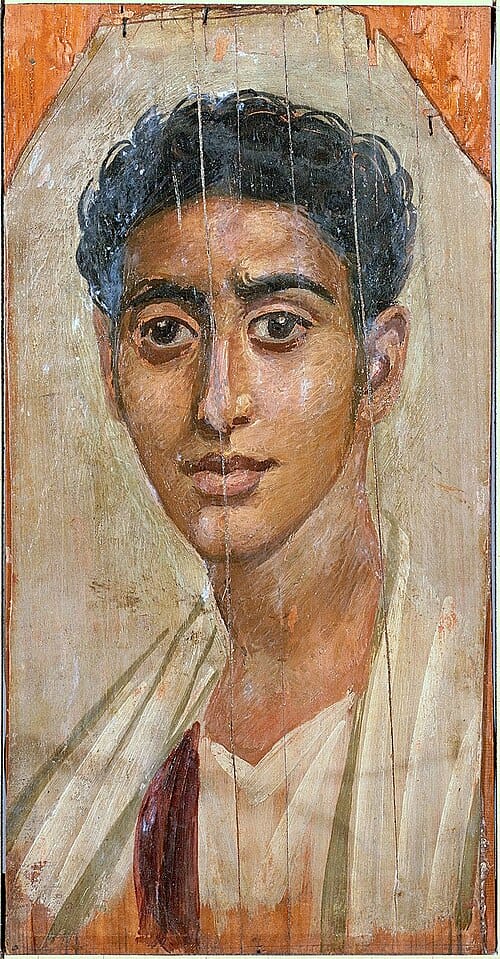
Greek and Roman painting in the classical tradition was universally praised in ancient sources. Pliny the Elder devotes substantial chapters of his Natural History to the great painters of the fourth century BCE, including Apelles, Zeuxis, and Parrhasius, and describes their technical achievements in terms that make clear panel painting was the most prestigious form of art in the ancient Mediterranean world. Almost nothing survives. The paintings Pliny describes are gone. What we have from the Greek and Roman world are wall paintings (primarily the Pompeian frescoes), mosaic floors that echo lost panel compositions, and a few decorated wooden objects. The Fayum mummy portraits are the only surviving large group of classical-era panel paintings made in the tradition that ancient authors described as the summit of the art.
That makes them irreplaceable as evidence for the visual language of Roman portraiture as it was actually practised rather than as it was rendered in stone or bronze. The specific conventions of the Fayum portraits, the three-quarter turn of the head, the large iris with its precisely placed catchlight, the asymmetry introduced into the mouth to prevent the face from reading as a mask, the hierarchy of technical investment between the face (always the most worked passage) and the clothing (more schematic), all of these appear to be conventions shared with the painted portraits that once hung in Roman houses across the empire and are now lost. The Fayum corpus is, in Marie Svoboda’s words in a Getty podcast, the beginning of the painting technology that carries forward for two thousand years after its making.
The ongoing APPEAR research, including the second APPEAR volume scheduled for February 2026, continues to add technical depth to this picture. Each panel that submits to imaging, each binder identified by mass spectrometry, each wood species confirmed by microscopy adds to the collective understanding of an industry that operated for at least two and probably three centuries, producing portraits whose best examples still carry the names and faces of the people they were made to preserve.
Sources: Marie Svoboda and Caroline R. Cartwright, eds., Mummy Portraits of Roman Egypt: Emerging Research from the APPEAR Project, J. Paul Getty Museum, 2020. Susan Walker and Morris Bierbrier, Ancient Faces: Mummy Portraits from Roman Egypt, British Museum Press, 1997. Lorelei H. Corcoran and Marie Svoboda, Herakleides: A Portrait Mummy from Roman Egypt, J. Paul Getty Museum, 2011. Metropolitan Museum of Art, “Ancient Faces: Mummy Portraits from Roman Egypt,” exhibition catalogue, 2000. Walters Art Museum Journal, “Findings from an Examination of Two Mummy Portraits,” vol. 74. Euphrosyne Doxiadis, The Mysterious Fayum Portraits: Faces from Ancient Egypt, Thames and Hudson, 1995. Klaus Parlasca, Mumienporträts und verwandte Denkmäler, Steiner, 1966.